
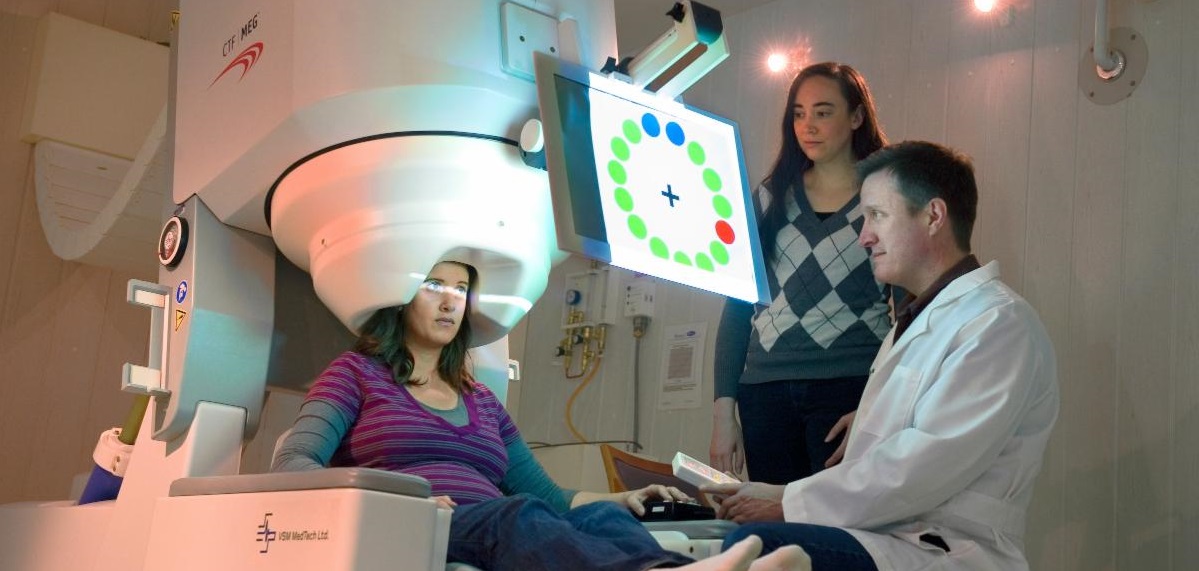
Atrium Health Wake Forest Baptist is one of just 34 clinical sites nationwide offering MEG, and the only one in North Carolina and surrounding states. That means you can access advanced brain imaging close to home.
Our experts use this cutting-edge brain imaging technique to help diagnose and treat complex neurological problems – providing complete, high-quality care tailored to your needs.
What is MEG?
Magnetoencephalography (MEG) is a safe, non-invasive brain scan that shows how your brain is working in real time. It’s one of the most advanced imaging methods of its kind.
MEG uses highly sensitive sensors to detect tiny magnetic signals created by your brain’s electrical activity. These signals help doctors understand how different areas of your brain function.
Who Might Benefit from MEG?
MEG may be recommended if you have epilepsy, a brain tumor or another condition affecting how your brain works.
MEG is often used to:
- Find the exact source of seizures
- Map important brain areas before surgery
- Plan treatment close to regions that control language, movement, sensation, vision, or memory
If your neurologist thinks MEG could help with diagnosis or treatment planning, they can refer you to our team.
What are the Advantages of MEG?
MEG plays an important role in diagnosing and treating complex brain conditions, particularly epilepsy. As part of our Comprehensive Epilepsy Center, MEG helps our specialists pinpoint exactly where seizures begin in the brain.
Key benefits of MEG include
- Safe and non-invasive: MEG scans are very safe. No needles, no radiation, and no known risks.
- Real-time brain activity: MEG shows how your brain works during tasks like speaking, moving, or listening – not just what it looks like.
- Highly precise: MEG can detect even the smallest signals deep in the brain, helping doctors accurately locate problems like seizures or tumors.
- Better treatment planning: MEG helps your care team create a personalized plan to reduce or stop seizures and guides safe surgical decisions that protect brain function.
Why Choose Us for MEG
With the region's only MEG program, we offer access to this highly specialized technology, close to home.
Our team includes experts in neurology, neurosurgery and brain imaging, along with doctorate-level MEG scientists who add deeper insight to complex cases.
These scientists help:
- Analyze brain signals with advanced techniques
- Match brain activity to your own MRI images for greater accuracy
- Create highly detailed maps of critical brain function to support complex surgical planning and advanced clinical decision-making
This level of expertise – often found only at academic medical centers – helps your care team understand how your brain works and choose the best treatment options.
How to Prepare for a MEG Scan
Getting ready for a MEG scan is simple.
Because MEG is very sensitive to magnetic signals, it’s important to remove anything that might interfere with the scan. This includes jewelry, watches, and clothing with metal parts.
You may also be asked to avoid makeup or hair products on the day of your scan. Your doctor will let you know if you need to avoid certain foods, drinks or medications.
Before the scan begins, small stickers (called head positioning coils) may be placed on your head. These help the MEG machine track your head’s position during the scan. In some cases, an EEG may be done at the same time to give doctors even more information about your brain activity.
What to Expect During a MEG Scan
During the scan, you’ll lie down or sit in a chair. The MEG machine looks like a large helmet – only your head goes inside, and it’s open in the front so you won’t feel enclosed. A specialist will help you get comfortable and explain what to expect.
You’ll need to stay as still as possible during the scan to get clear results. Depending on what your doctor is looking for, you may be asked to relax, listen to sounds, look at pictures, read words or move your hands. Some patients even sleep during the scan.
Most scans take about an hour, but the full visit may take a little longer. It typically does not require an overnight stay.
MEG Research
At Atrium Health Wake Forest Baptist, we use MEG in groundbreaking research that will shape the future of neurological care.
Our researchers are leading cutting-edge studies to better understand a wide range of brain conditions, including epilepsy, stroke, PTSD, dementia, schizophrenia, traumatic brain injury (TBI), substance use disorders, infectious diseases and more.
These studies will help us develop more personalized treatments and bring new hope to patients.
For Providers
We welcome referrals from neurologists, neurosurgeons, oncologists and other specialists across Advocate Health and beyond.
Common referral indications include:
- Medically refractory focal epilepsy
- Pre-surgical localization of seizure onset zones
- Functional mapping of language, motor and sensory cortex before epilepsy or tumor surgery
- Evaluation of lesion-negative epilepsy when MRI and EEG results are discordant or unclear
- Re-evaluation of patients who have had prior surgery or device therapy
What we provide:
- Standard clinical MEG interpretations, including dipole modeling and source localization
- Advanced SAM-based analytics and other high-level analyses performed by PhD-trained MEG scientists
- Results co-registered to each patient’s MRI and summarized in a clear, actionable report
- Integration with epilepsy surgery conferences and multidisciplinary care planning
To discuss a case or arrange a referral, please call our MEG team at 336-716-1881.