
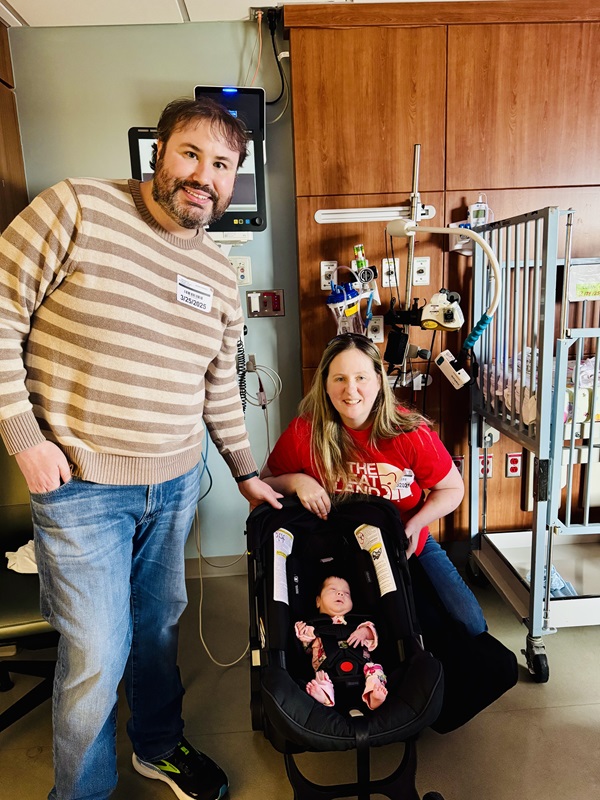
A long road to pregnancy
For Cassandra King, getting pregnant was never simple.
For more than three years, she and her husband tried to conceive. There were miscarriages. Hormone treatments. Procedures that left her physically and emotionally drained.
“I had been through so much just to get to that point,” Cassandra said. “This pregnancy felt like our one real chance.”
So when she finally became pregnant, the joy felt fragile and precious. To celebrate, she and her husband took a long-planned babymoon to Jamaica in the fall—hoping for rest after years of stress.
Instead, the trip would change everything.
A sudden, terrifying crisis
At 17 weeks pregnant, Cassandra began experiencing severe pain in her upper back and shoulder, pain she initially dismissed as pregnancy discomfort. But the pain intensified. She became nauseated. She vomited. Something was clearly wrong.
Doctors in Jamaica discovered she was having a heart attack—later diagnosed as spontaneous coronary artery dissection (SCAD), a rare condition that often affects otherwise healthy young women during or after pregnancy.
Because the hospital in Jamica lacked the resources to intervene, Cassandra was transferred by ambulance — during a hurricane — then medevacked back to the United States. She arrived at Atrium Health Wake Forest Baptist in Winston-Salem suffering from advanced heart failure.
Her ejection fraction, the percentage of blood pumped out with each heartbeat, had dropped to about 25–30 percent, far below normal.
“She was very sick,” said Dr. Bart Imielski, a cardiothoracic surgeon at Atrium Health Wake Forest Baptist. “And she was early in pregnancy, which made everything more complicated.”
An impossible decision
Given Cassandra’s condition, the care team brought together specialists in heart failure, cardiothoracic surgery, maternal-fetal medicine, cardiac and obstetric anesthesia and neonatology.
Cassandra was counseled by the multidisciplinary team regarding pregnancy management options. Based on established clinical guidelines, the safest recommendation was clear: a medically necessitated interruption of the pregnancy to save Cassandra’s life.
Cassandra was told this directly. Cassandra recalls “they were trying to save me. I understood that. But it was devastating.”
The care team walked through every option with Cassandra. Together, Cassandra and her doctors discussed the risks and benefits and after compassionate counseling and thoughtful consideration, Cassandra chose to continue the pregnancy.
Shared decision-making, not defiance
Dr. Imielski is careful to emphasize what happened next.
“Shared decision-making is central to how we practice,” he said. “In complex situations like this, our job is to talk through the risks and options and support the decision that best reflects the patient’s values.”
The team respected Cassandra’s autonomy and committed to doing everything possible to support her choice safely.
“That meant asking a very hard question,” Imielski said. “Is there a way to keep her alive long enough for the baby to reach viability?”
Maternal-fetal medicine specialists worked alongside the heart team, helping weigh maternal risk, fetal development and the patient’s goals as the plan evolved.
“In complex pregnancies such as Cassandra’s, care has to be deeply collaborative,” said Dr. Talla Widelock, a maternal-fetal medicine specialist at Atrium Health Wake Forest Baptist. “It’s about listening to the patient, understanding their values and goals, and supporting the patient’s health and well-being through shared decision-making with the entire care team.”
But there were no guarantees. And there was no established playbook.
A critical turning point
After weeks of careful monitoring and initial stabilization, Cassandra was discharged but represented again in late December. Cassandra’s condition had worsened and her heart was struggling. On New Year’s Eve, test results revealed she was in cardiogenic shock, and she was moved back to the ICU. Time was running out. The team worked swiftly to come up with a treatment plan to stabilize Cassandra.
A novel approach and plan for care
The answer and plan developed involved a rare, highly complex strategy, combining two forms of advanced cardiac support:
- ECMO, a form of life support that temporarily takes over the work of the heart and lungs
- a temporary mechanical circulatory support device, a catheter-based heart pump that helps unload and support the failing heart
She was rushed to the operating room on New Year’s Day. There, the role of cardiac anesthesia was critical. In the operating room, cardiac anesthesiologist Dr. Karuna Puttur Rajkumar would plan to continuously balance Cassandra’s blood pressure, oxygenation and heart function, in turn protecting the baby.
“In a case like this, you are truly caring for two patients at once,” Rajkumar said. “Every medication, every adjustment, every decision has to account for both the mother and the fetus. The margin for error is extremely small, and communication among the team is everything.”
Cassandra remembers holding Dr. Rajkumar’s hand before losing consciousness. "I told her, ‘I don’t want to die,’” Cassandra said. “She looked at me and nodded. That was enough.”
Inside the OR, specialists from cardiothoracic surgery, cardiac and obstetric anesthesiology, maternal-fetal medicine and neonatology coordinated in real time, planned for both possible outcomes, emergency delivery or continued pregnancy. They were also ready to pivot in seconds if Cassandra or the baby destabilized.
“This kind of support had been used in pregnancy before,” Imielski said. “But almost always later in gestation or postpartum. Using it in this circumstance has never been done before”.”
As anesthesia was administered, Cassandra’s blood pressure collapsed. The baby’s heart rate dropped.
“We had minutes,” Imielski said. “If we couldn’t stabilize her, Cassandra’s life was at risk and we would have had to deliver the baby immediately”.
Dr. Imielski placed her on ECMO, stabilizing her circulation. Once her condition improved, he transitioned her to the temporary heart pump.
“Everything came together at exactly the right moment,” Imielski said.
Cassandra would later learn that her case is the first documented case in the United States to successfully do just that. “It felt like we were walking into completely uncharted territory,” she said.
That plan would soon be put to the test.
Thirteen days on life support
For nearly two weeks, Cassandra lived with the heart pump supporting her circulation. Each day, she pushed herself to walk laps around the intensive care unit—despite pain, fear and exhaustion.
“I knew every day mattered,” she said. “Every day inside me gave my baby a better chance.”
Maternal-fetal medicine and neonatal specialists worked closely alongside the heart team, continuously reassessing both maternal stability and fetal development as Cassandra’s condition evolved.
Eventually they reached another crossroad.
“At some point, the risk shifts,” Imielski said. “Waiting too long or acting too soon could harm the mother and baby.”
Together, the team and Cassandra decided it was time.
A birth against the odds
On Jan. 15, at 27 and a half weeks pregnant, Cassandra returned to the operating room—this time with more than 30 clinicians present, representing maternal-fetal medicine, cardiothoracic surgery, cardiac and obstetric anesthesiology, and neonatology.
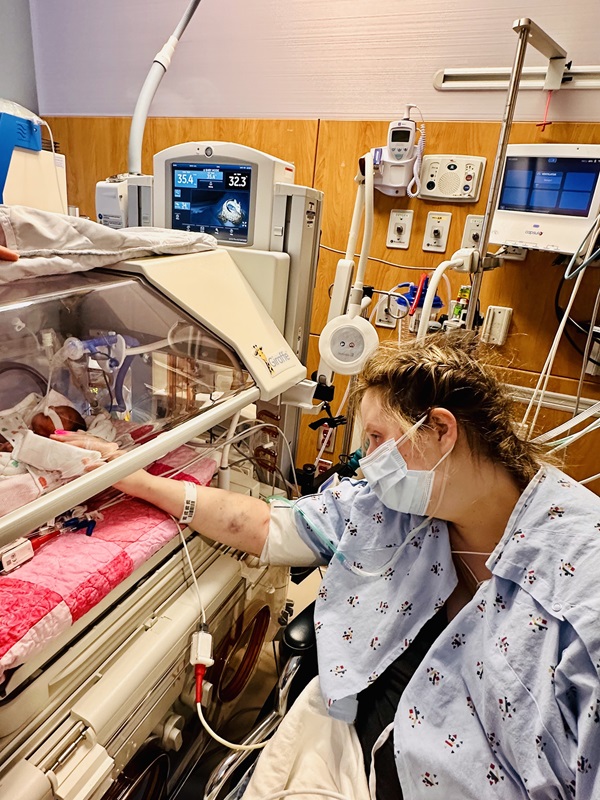
Her daughter was born weighing 2 pounds, 4 ounces.
The baby was taken to the NICU. Cassandra returned to the cardiac ICU alive, stable, and still supported by the heart pump.
Cassandra was unconscious during the delivery. “I woke up later in the CICU and learned she was alive and in the NICU with her father,” she said.
Because her condition allowed it, the team made an extraordinary commitment to coordinate a special moment: together the ICU, Birth Center and Neonatology nursing and physician teams, transported Cassandra—heart pump and all—to the NICU so she could see her daughter.
“That moment meant everything,” Cassandra said.
Recovery and reflection
Today, a year later, Cassandra has completed cardiac rehabilitation, her heart function has improved after additional interventions. She no longer requires evaluation for transplant.
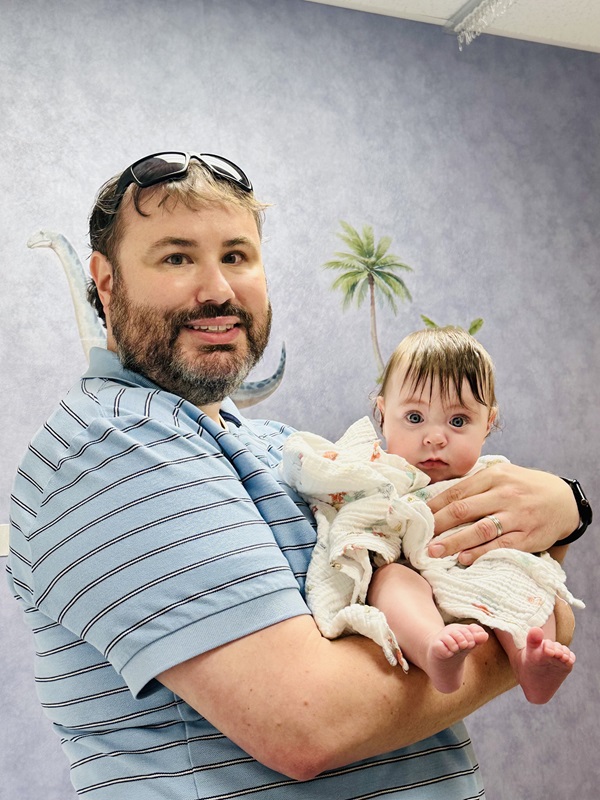
Her daughter is thriving.
“She’s never met a stranger,” Cassandra said, smiling. “She’s the happiest baby.”
For Cassandra’s father, Dr. Thomas Meloy, the outcome still feels surreal.
“Last year at this time, I wouldn’t have dared pray for an outcome this good,” he said. “There were so many ways this could have gone wrong—and it didn’t. I am well aware that many, many services and people were involved in creating this incredible outcome. I am certain that my granddaughter would not be here, and likely not my daughter either, except for the intelligence, clinical skill, and leadership demonstrated. My family will be eternally grateful.”
In gratitude, the family made a philanthropic gift to support cardiovascular anesthesia education at Atrium Health Wake Forest Baptist.
“I wanted to support the training of physicians like Dr. Rajkumar that made this possible,” Meloy said. “What they did matters.”
A new frontier—handled with care
Dr. Imielski is clear about what this case does—and does not—represent.
“This is not a new standard of care,” he said. “But it does open a new frontier.”
He hopes the story highlights what’s possible when patient values, medical expertise and teamwork align.
“This only works in a place where everyone is talking to each other and no one works in silos,” he said. “Where the patient is part of and center to the decisions”.
Learn more about cardiothoracic surgery and maternal fetal medicine at Atrium Health Wake Forest Baptist.